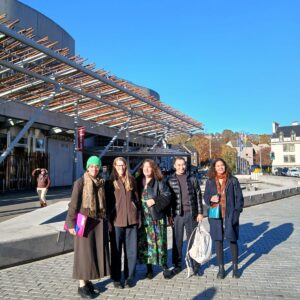
Yesterday WSC’s team presented Gillian Martin MSP, Scotland’s Cabinet Secretary for Climate Action and Rural Affairs, with a detailed new Roadmap towards Fair Work in seasonal agriculture.
The Fair Work Convention, an independent advisory body to the Scottish Government, published its Fair Work Framework in 2016. In 2021, the Scottish Government followed with its first Action Plan, setting out a bold ambition to become a Fair Work Nation, where every worker has effective voice, opportunity, fulfilment, security and respect.
“The Scottish Government’s Fair Work ambition is still far from becoming reality for thousands of workers on tied and temporary visas,” said Caroline Robinson, WSC’s Executive Director. “Its plans extend beyond current UK national law, which in itself is not even being met for people working in seasonal agriculture on Scotland’s farms.”
Unpaid work, isolation and dangerous housing
Workers have consistently reported serious problems to WSC, including not being paid for hours worked, discrimination and racist abuse, and being forced to rent dirty, dangerous, end-of-life caravans with no storage space or privacy.
They also report health and safety gaps, such as no nearby handwashing or toilet facilities, no protective equipment, and having to eat lunch sitting in the mud due to no tables or seating being provided. Without access to transport, many also face isolation, loneliness and problems reaching medical care when they need it.
At the heart of these issues lies a systemic problem: a visa that ties seasonal workers to a single sponsor. This creates fear among workers to speak up about problems, or to move on when a job isn’t working out.
Worker power in action
Over 2025–26, through WSC’s Worker Power programme, seasonal agricultural workers explored the Fair Work Framework and responded to each dimension based on their experiences. The result is a Roadmap that spans all five Fair Work dimensions and pinpoints exactly who can do what, and where to start.
At yesterday’s meeting the Cabinet Secretary expressed shock in response to these conditions, describing the asks as “basic” and said the fact that workers “have had to put them in a document suggests a lot of people don’t have access to them.” She committed to raising housing standards for seasonal agricultural workers with the Coalition of Scottish Local Authorities (COSLA), and to following up on the Scottish Government Commitment to National Housing Standards with the Cabinet Secretary for Social justice and Housing, Shirley-Anne Somerville MSP. She also committed to raising worker pay, rights and information on services with Scheme Operators and farmers unions – the National Farmers Union, Scotland.
“We thank the Cabinet Secretary for her commitments” said Caroline Robinson. “Scotland’s Fair Work ambitions will only be realised when every worker is treated with dignity and respect – no matter their visa type, job or nationality. This Roadmap outlines exactly how to turn this into practice on Scotland’s farms.“
“Employers can easily make some changes this season, at very little cost: tables for breaks, toilets nearby, free protective clothing and clear records of hours worked. Other changes need more work, we invite everyone involved to read this Roadmap, meet with us and commit to every step needed to create change.”
What Fair Work means to Scotland’s seasonal workers
- Effective voice means being heard, trusted and able to take part in decisions about work and wellbeing without fear of retribution. However, WSC’s 2025 data shows workers regularly being threatened with dismissal or punished for raising issues – including being denied work for days, which effectively removes their income. Some were warned not to contact organisations like WSC or trade unions. Unions are not currently present in seasonal agricultural workplaces, and workers report having had no opportunity to engage with them.
- Opportunity means genuine choice, fair access to work and a reliable, fair income. It means being treated equally to other employees, not disadvantaged through how products or equipment are allocated.
- Security means, above all, being paid for every hour worked – with clear information about how pay is calculated and a say in how it is structured.
- Fulfilment goes beyond the working day: being part of local communities, shopping, accessing services, feeling physically and mentally well, with places to rest during work. And because most workers live on geographically isolated farms without a car, transport is key to health, education, food and a social life.
- Respect means being treated with dignity by managers and colleagues. Where housing is tied to the farm, it means homes that meet national minimum standards and don’t cost far more than market rates. It means workplaces where concerns are discussed rather than punished, and where employers follow and enforce health and safety law.
Seasonal workers’ vision for a truly fair and welcoming Scotland
“Now everyone who works on the farm is treated with respect and understanding. They understand that we are far away from home and family, and that we are under stress. They don’t make us feel nervous anymore, and they are no longer immediately rude to us when we make mistakes. The attitudes are good and warm, everything is explained properly and people do not shout at us at work.”
“The kitchen is fully equipped with fridges large enough for all of us, so we can cook and keep the leftovers. We live in bigger caravans with fewer people. The caravans are clean, warm, insulated and cheaper, with utility bills included in the rent. Everything necessary is inside: a toilet and a shower, so we don’t need to go outside.”