At the Worker Support Centre (WSC), we believe that every worker deserves to live in safety and dignity. But today’s BBC news report on farm worker housing in Scotland has exposed just how far we still are from that reality.
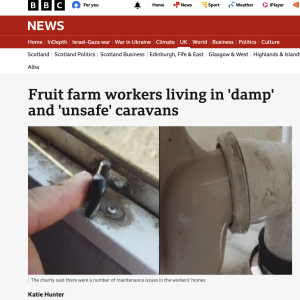
Footage shared on BBC Radio Scotland this morning (17 December 2025 at 1hr 22m) – also to be featured on BBC TV News at 6:30pm on 17 December – shows seasonal agricultural workers living in squalid conditions. Video clips reveal sodden carpets, broken windows and doors and a leaking toilet.
One worker described his living quarters as “terrible, cold” and told the BBC that the conditions affected his physical and mental health.
These ‘homes’ are damp, draughty and unfit for human habitation – yet our research shows that workers are routinely charged more than 20% of their wages to live in them, often sharing with five others in spaces rented out for nearly £2,000 a month.
At WSC, we hear stories like this regularly: people doing back-breaking work to feed Scotland’s families, returning each night to cramped, freezing, unsafe housing. Women workers report being forced to share with men they don’t know. Others have reported injuries caused by broken fixtures, and physical symptoms of damp and mould.
This is not new. For years, seasonal workers have been warning that the housing tied to their jobs is unsafe – and that a gap in housing law has left them without the same protections everyone else relies on. Even people renting AirBnB yurts for the weekend are better protected in law.
There are signs of progress. Following 18 months of worker-led advocacy, Housing Secretary Màiri McAllan MSP recently confirmed that the Scottish Government will introduce housing standards for seasonal agricultural workers for the first time. WSC is calling for the implementation of Section 315 of the Housing (Scotland) Act 1987, an over 30 year old law which allows for such standards but has never been implemented.
But workers cannot wait another season for safe housing. With the next Scottish Parliament elections due in May, time is running out to get new standards in place – and to ensure they are properly enforced.
“People who pick our food deserve the same basic right as anyone else: a safe, warm place to live” said Caroline Robinson, Executive Director of WSC “The Scottish Government’s commitment is a vital step – but it must move quickly. Every day of delay means more workers forced to live in conditions no one in Scotland – or the UK – should ever have to endure.”
The BBC report is yet another reminder that change is urgent – and achievable. By listening to workers and acting on their expertise, Scotland can set a new standard for how we treat the people who keep our food system running.